Variables#
Declaration/Assignment#
There are two ways to declare a variable:
1. Declare using a top-level var statement.#
var variable_name = 10; # variable is 10 when project first loads
var type_name variable_name; # initialized to struct defaults or zeros
var type_name variable_name = type_name { ... }; # explicit default values
2. Declare by assigning a value to the variable.#
The first assignment to a variable is considered its declaration.
variable_name = value;type_name variable_name = value;Variables for all sprites#
If a variable is assigned to in stage.gs, it will be declared as for all sprites.
Variables for this sprite only#
Variables are by-default declared as for this sprite only. If you want to declare a
variable for all sprites, assign to it in stage.gs.
Local Variables#
Local variables are accessible only within the procedure they are declared in.
The first assignment with the local keyword will declare a local variable, all further
uses of the variable will refer to the local variable. If a normal variable with the same
name exists, it will be shadowed.
proc my_procedure {
    local x = 0;
    x = x + 1;
}
In the compiled Scratch project, the variable x will be named as my_procedure:x.
Note
Local variables will have undefined behavior if the procedure is recursive, or is NOT a run-without-screen-refresh procedure.
Compound Assignment#
| Operator | Implementation |
|---|---|
x++; |
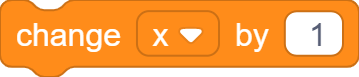 |
x--; |
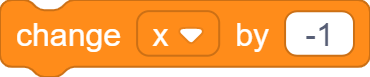 |
x += y; |
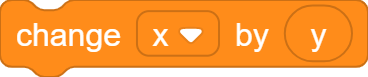 |
x -= y; |
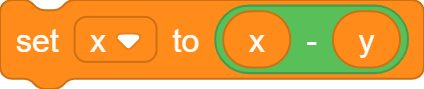 |
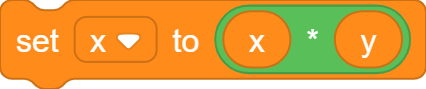
x *= y; |
 |
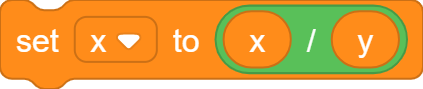
x /= y; |
 |
x //= y; |
 |
x %= y; |
 |
x &= y; |
 |
Show/Hide Variable Monitor#
show variable_name;hide variable_name;